
Alloy 718 (Inconel 718) Nickel Alloy
Alloy 718
Available on Request
- EN2.4668
- ENNiCr19Fe19Nb5Mo3
- UNSN07718
- AMS5662 / 5663
- TicariInconel® 718
Alloy 718 (2.4668) is a Ni-Cr-Fe superalloy age-hardened through Nb, Ti and Al, reaching Rm ≈ 1300–1450 MPa after solution treatment and ageing. Its slow ageing response eases welding; it is used up to 650 °C in turbine, rocket-engine and well equipment.
Spectral Analysis
wt. % · UNS N07718 ranges- Ni
- 50.0–55.0
- Cr
- 17.0–21.0
- Fe
- balance
- Nb+Ta
- 4.75–5.50
- Mo
- 2.80–3.30
- Ti
- 0.65–1.15
- Al
- 0.20–0.80
- C
- ≤0.08
Typical ranges according to the standard, for information only. The analysis on the material certificate applies on delivery.
01Material Properties
- Rm ≈ 1300–1450 MPa (solution treated + aged)
- Creep resistance up to 650 °C
- Tough also at cryogenic temperatures
- Sluggish ageing response → good weldability
- Good corrosion and oxidation resistance
02Applications
- Gas turbine discs, blades and casings
- Aerospace fasteners
- Rocket engine parts
- Oil and gas downhole equipment
- Cryogenic tanks and valves
03Delivery Condition
- Solution treated or solution treated + aged (AMS 5662 / 5663); bar, plate, forgings.
04Heat Treatment
Heat Treatment Steps
Ageing Diagram
Values are approximate and for information only; they vary with section size, heat and furnace conditions. Binding values are determined from the manufacturer’s data under laboratory conditions.
05Mechanical Properties
Values by heat-treatment condition; actual values depend on product form, section size and ageing parameters.
| Condition | Rm (MPa) | Rp0.2 (MPa) | A (%) | Hardness | Basis / note |
|---|---|---|---|---|---|
| Solution treated (955–980 °C) | — | — | — | ≈ 20–25 HRC | AMS 5662 delivery condition |
| Solution treated + aged | ≥ 1276 | ≥ 1034 | ≥ 12 | — | AMS 5663 min. (bar, forgings) |
| Solution treated + aged — typical | ≈ 1300–1450 | ≈ 1030–1200 | ≈ 12–25 | ≈ 40–45 HRC | Room temperature |
| Solution treated + aged, at 650 °C — typical | ≈ 1100 | ≈ 950 | — | — | Short-time tensile |
Minimum values apply to the stated standard and condition; typical values (≈) are for guidance. The applicable specification and material certificate govern for orders.
06Applicable Standards & Specifications
- AMS 5662 — Bars, forgings and rings (solution heat treated)
- AMS 5663 — Bars, forgings and rings (solution heat treated + precipitation hardened)
- AMS 5596 — Sheet, strip and plate (solution heat treated)
- ASTM B637 — Precipitation-hardening nickel alloy bars and forgings for high-temperature service
- ASTM B670 — Plate, sheet and strip for high-temperature service (UNS N07718)
- API 6ACRA — Age-hardened nickel alloys for oil and gas equipment (on request)
- NACE MR0175 / ISO 15156 — Sour (H₂S) service (on request)
A product specification and an inspection document are different things: e.g. AMS 4928 is a product specification, EN 10204 3.1 is a type of inspection document; one does not replace the other.
07Microstructure & Metallurgical Properties
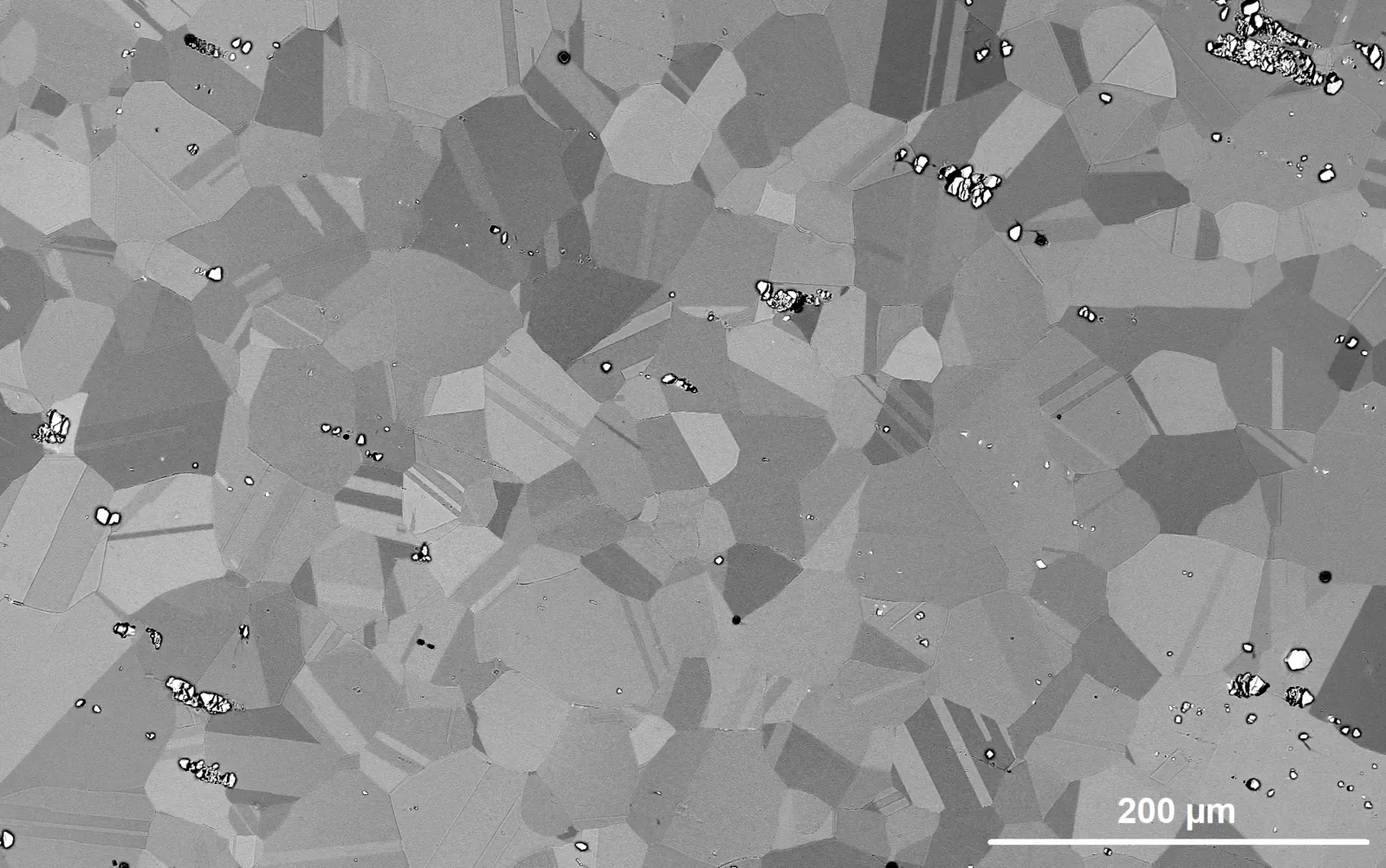
Typical microstructure informationAlloy 718 is an age-hardenable Ni-Cr-Fe-Nb superalloy. After solution treatment and ageing its microstructure typically consists of an FCC γ matrix with finely dispersed γ'' and γ' precipitates, δ phase at grain boundaries and primary NbC carbides.
Typical metallurgical characteristics
- FCC γ matrix
- Ageing precipitates: γ'' (main) and γ'
- δ phase at grain boundaries; primary NbC / TiN
- γ'' → δ transformation and strength loss in long-term service above 650 °C
- Properties influenced by solution and ageing parameters
- 1.Typical microstructure
- In the solution-treated + aged condition: γ matrix with nanometre-scale γ'' (Ni₃Nb) and γ' (Ni₃(Al,Ti)) precipitates, needle- or plate-shaped δ phase at grain boundaries and discrete NbC / TiN particles. The solution-treated-only condition contains no γ'' / γ'.
- 2.Heat treatment influence
- Solution treatment at 955–980 °C stays below the δ solvus, so some δ phase remains at grain boundaries and restricts grain growth. Double ageing (720 °C + 620 °C) precipitates γ'' and γ', raising hardness from about 20–25 HRC to 40–45 HRC; solution-treated and aged 718 do not show the same microstructure.
- 3.Grain structure
- Grain size depends on forging temperature, amount of deformation and solution temperature; grain-boundary δ phase limits grain growth. Fatigue-critical parts call for a fine, uniform grain structure.
- 4.Carbide / precipitate distribution
- Main strengthening phase γ'' (Ni₃Nb), with γ' (Ni₃(Al,Ti)) as secondary; δ (Ni₃Nb) at grain boundaries; primary NbC and TiN. Castings and weld metal can form Laves phase associated with Nb segregation. γ'' and γ' precipitates are not resolvable by optical microscopy; the imaging method used (optical, SEM, TEM) should be stated.
- 5.Metallographic examination
- Batch-specific metallographic examination is available upon request. A microstructure image alone does not prove chemical analysis, mechanical properties or certificate compliance.
Available technical documentation
- Chemical composition certificate
- Mechanical test report, where available
- Heat treatment information, where available
- Metallographic examination, upon request
Typical microstructure information. Actual microstructure may vary depending on manufacturing route, product form and heat treatment.
08Is there a better material?
Grades in the same material family as Alloy 718 with higher wear resistance and higher impact resistance (toughness); up to two suggestions under each heading. Which one fits depends on the application's priority requirement.
Higher wear resistance
Our list has no grade with higher wear resistance than Alloy 718 without a marked trade-off in its other critical properties.
Higher impact resistance (toughness)
- Alloy 625 (Inconel 625) Nickel Alloy
Toughness: High → Very high
Trade-off: High-temperature strength, Strength, Wear resistance
Suggestions are based on the critical property levels in our grade data; an improvement in one property may require a trade-off in another. The final selection must be made by technical evaluation against operating conditions, heat treatment and specification.
For more information, browse our Technical Insights09Move Metal Supply Options
Move Metal is not a producer; we source the grade to your specification through our international producer and supplier network. Dimensions, quantity, delivery condition and documentation requirements are reviewed together.
Product forms
- Round bar
- Plate
- Sheet
- Tube
- Forgings
Documents and testing
- EN 10204 3.1 inspection certificate
- EN 10204 3.2 inspection certificate (upon request, third party)
- Ultrasonic testing (e.g. ASTM E2375), upon request
- Intergranular corrosion testing (e.g. ASTM G28)
- Grain size report (ASTM E112)
Supply status: Available on Request
Request Alloy 718 QuotationNot sure if Alloy 718 is the right material for your application?
Evaluate candidate materials by application, operating conditions and priority properties with the Material Selection Guide.
Find the Right MaterialGrades in the Same Group
Back to GroupTechnical resources for this material
Have a material requirement?
Send us your specification, drawing or RFQ. Our team will review the requirement and identify a suitable supply option.