
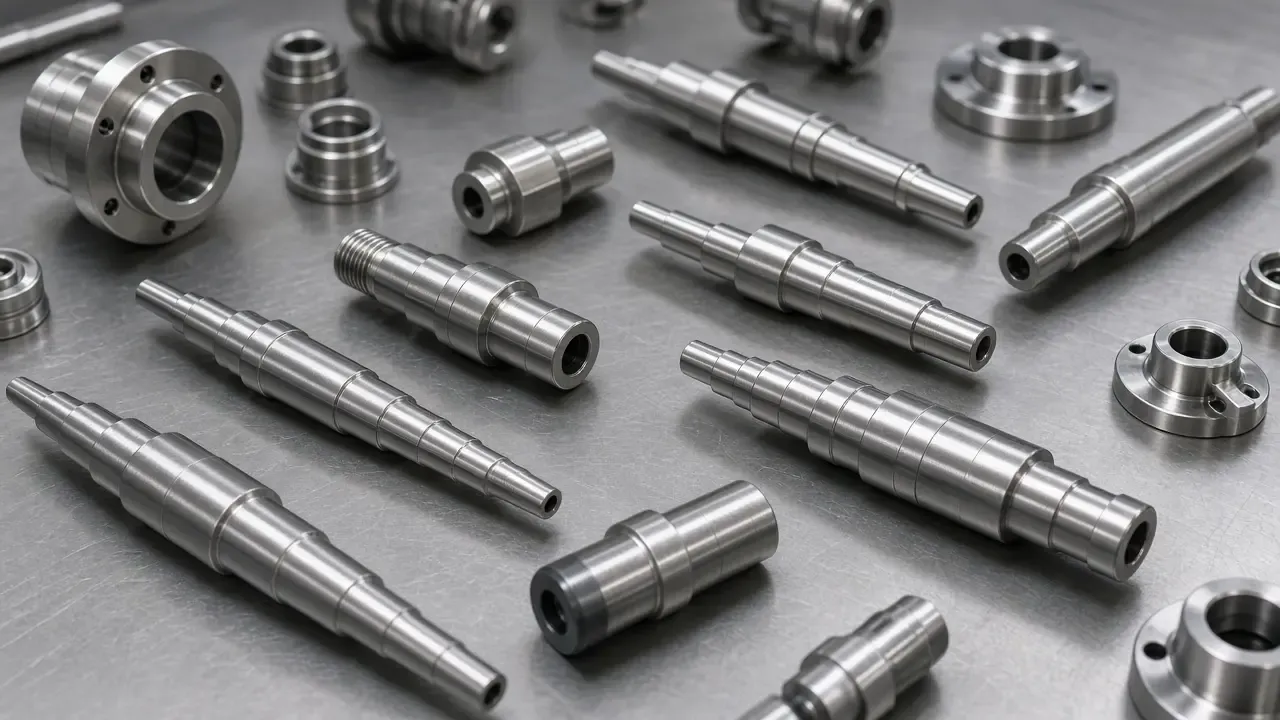
17-4 PH • 15-5 PH • PH 13-8 Mo
Stainless & PH Steels
17-4 PH and 15-5 PH supplier in Turkey. Stainless and precipitation-hardening steels combining corrosion resistance with high strength. Specification-driven sourcing for aerospace, defense and demanding industrial applications.
01
Stainless & PH Steels
Precipitation-hardening grades 17-4 PH, 15-5 PH and PH 13-8 Mo together with martensitic stainless grades, evaluated with their heat-treatment conditions and mechanical property requirements.
Typical applicationsAerospace structural parts, defense systems, valve and pump components, parts requiring a balance of corrosion resistance and strength.
431 Stainless Steel
X17CrNi16-2·431
Martensitic stainless steel containing chromium and nickel. Achieves high tensile strength through heat treatment, machines and polishes well. Offers good corrosion resistance; common for shafts, bolts and pump parts.
440B Stainless Steel
X90CrMoV18·440B
Martensitic stainless steel with high hardenability and wear resistance. Provides good resistance to oxidation and corrosion and is suitable for elevated-temperature service. Its good machinability makes it suitable for CNC machining, milling and other mechanical processing. Magnetic.
PH 13-8 Mo Stainless Steel
1.4534·X3CrNiMoAl13-8-2·S13800
Special precipitation-hardening stainless steel developed for aerospace. PH 13-8 Mo offers better corrosion resistance than 17-4 PH and 15-5 PH. Magnetic.
17-4 PH Stainless Steel
1.4542·X5CrNiCuNb16-4·630
Widely used precipitation-hardening (PH) stainless steel. Combines corrosion resistance close to austenitic stainless steels with the ability to reach high mechanical strength through heat treatment (H900–H1150), like martensitic grades. Preferred for its high strength and good machinability; suitable for forging, casting and cold forming. Magnetic.
15-5 PH Stainless Steel
1.4545·X5CrNiCu15-5·S15500
High-strength precipitation-hardening stainless steel covered by ASTM A564. Compared with 17-4 PH, 15-5 PH offers better mechanical properties and a cleaner structure. Magnetic, resistant to high temperatures, highly ductile and resistant to seawater.
420 Stainless Steel
X20Cr13·420·S42000
Martensitic stainless steel hardenable by heat treatment. Combines moderate corrosion resistance with mechanical strength and wear resistance; used in the quenched and tempered or hardened condition.
420C Stainless Steel
X46Cr13·420C
Martensitic stainless steel with higher carbon content than 1.4021. Provides higher hardness and wear resistance; used where cutting edges and dimensional stability are required.
316L Stainless Steel
X2CrNiMo17-12-2·316L·S31603
Molybdenum-alloyed, low-carbon austenitic stainless steel. High corrosion resistance in chloride-containing environments and acids; the low carbon content prevents intergranular corrosion after welding.
316Ti Stainless Steel
X6CrNiMoTi17-12-2·316Ti·S31635
Titanium-stabilised, molybdenum-alloyed austenitic stainless steel. Combines corrosion resistance similar to 316L with better strength and intergranular corrosion resistance at elevated temperatures.
440C Stainless Steel
X105CrMo17·440C·S44004
Martensitic stainless steel reaching the highest hardness within its class. High carbon and chromium content combine wear resistance with corrosion resistance; used in bearing and cutting applications.
304 Stainless Steel
X5CrNi18-10·304·S30400
The most widely used austenitic stainless steel. Combines good corrosion resistance, formability and weldability at an economical price; the standard for general-purpose stainless applications.
321 Stainless Steel
X6CrNiTi18-10·321·S32100
Titanium-stabilised austenitic stainless steel. Resistant to intergranular corrosion in the 400–800 °C range; used instead of 304 for welded parts operating at elevated temperature.
2205 Duplex Stainless Steel
X2CrNiMoN22-5-3·2205·S32205 / S31803
Ferritic-austenitic (duplex) stainless steel. Combines about twice the yield strength of austenitic steels with high pitting and stress corrosion cracking resistance in chloride media.
Common Specifications
- ASTM
- AMS
- EN
- UNS
- Customer specifications
What We Review
- Grade
- Standard
- Dimensions and tolerance
- Heat-treatment condition (H900, H1025, H1150 …)
- Testing requirements
- Certification
- Origin
Aerospace and defense specifications
Materials to aerospace and defense specifications are evaluated upon request. Materials with similar chemical designations may differ significantly in applicable standards, heat treatment, testing and certification requirements.
Available Forms
- Round bar
- Flat bar
- Plate
- Sheet
- Forgings
- Cut-to-size
Available forms may vary by grade and specification.
Have a material requirement?
Send us your specification, drawing or RFQ. Our team will review the requirement and identify a suitable supply option.