
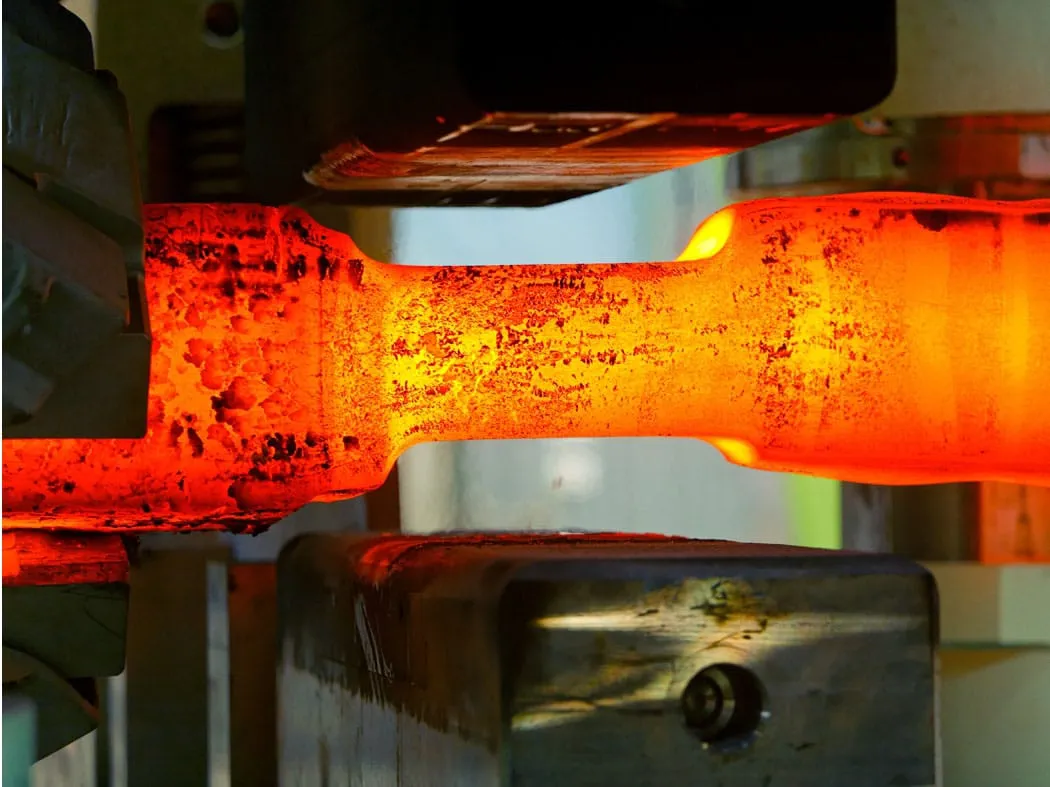
Quenched and tempered, case-hardening, nitriding and spring steels for machine components.
Engineering Steels
The basic materials for machine components such as shafts, gears, fasteners, pins, bushings and springs. Quenched and tempered steels provide strength with toughness, case-hardening steels a hard surface with a tough core, nitriding steels high surface hardness with minimal distortion, and spring steels a high elastic limit. We source grades to EN 10083 / 10084 / 10085 / 10089 in the required delivery condition (annealed, quenched and tempered, peeled, ground) according to specification.
01
Overview
Engineering steels are non-alloy and low-alloy steels used in machine components, where heat treatment provides the required strength, toughness and surface hardness. They are classified by the heat treatment applied: quenched and tempered steels (EN 10083) are hardened and tempered at high temperature; case-hardening steels (EN 10084) have low carbon and are hardened after carbon enrichment of the surface; nitriding steels (EN 10085) are nitrided at low temperature after quenching and tempering; spring steels (EN 10089) are hardened and tempered for a high elastic limit. Cr, Mo and Ni determine hardenability, i.e. how deep the hardness reaches into the section, so the same grade gives different mechanical values at different section sizes and delivery conditions. Selection weighs section size, required mechanical values, surface treatment, welding and machining requirements.
- Quenched and tempered: 42CrMo4, 34CrNiMo6, 30CrNiMo8 — strength–toughness balance
- Case-hardening: 16MnCr5, 20MnCr5, 18CrNiMo7-6 — hard case (58–62 HRC), tough core
- Nitriding: 31CrMoV9, 34CrAlNi7 — 800–1100 HV surface, low distortion
- Spring: 51CrV4, 54SiCr6 — high elastic limit and fatigue strength
- Bearing and oil and gas grades (100Cr6, 4145H, 4330V): to specification, on request
- Mechanical values depend on section size; Ni and Mo alloyed grades are considered for large sections
02
Material Grades
02.1
Quenched and Tempered Steels
Hardening + high-temperature tempering for a strength–toughness balance; EN 10083.
Typical applicationsShafts, gears, crankshafts, bolts, hydraulic parts
42CrMo4 (4140) Engineering Steel
42CrMo4·4140·G41400
A Cr-Mo heat-treatable steel equivalent to AISI 4140 and widely used in machine building. Reaches 900–1100 MPa as +QT up to 100 mm; since the surface can be induction-hardened or nitrided, it is preferred for shafts, gears and bolts.
34CrNiMo6 (4340) Engineering Steel
34CrNiMo6·~4340 (yakın)
Ni-Cr-Mo alloyed steel for quenching and tempering, close to AISI 4340 (composition differs). In the +QT condition it pairs 1000–1200 MPa tensile strength with toughness that holds at low temperatures; used for crankshafts, heavily loaded shafts and landing-gear parts.
25CrMo4 (4130) Engineering Steel
25CrMo4·4130·G41300
Cr-Mo steel for quenching and tempering, equivalent to AISI 4130, with carbon held at 0.22–0.29 %. Tough and weldable with preheating, it is used for welded tubular frames, aerospace structural parts and fasteners.
C45E (1045) Carbon Steel
C45E·1045·G10450
Unalloyed steel for quenching and tempering to EN 10083-2 with 0.42–0.50 % carbon (C45E / AISI 1045). Its limited hardenability suits sections up to about 25 mm; used for shafts, pins and gears whose surface is induction or flame hardened.
34CrMo4 (4135) Engineering Steel
34CrMo4·4135·G41350
A Cr-Mo quenched and tempered steel equivalent to AISI 4135, sitting between 25CrMo4 and 42CrMo4 in carbon content. Gives 800–950 MPa in the +QT condition at 40–100 mm; used for shafts, studs, gas cylinders and pressure-bearing parts.
30CrNiMo8 Engineering Steel
30CrNiMo8·~4340 (yakın)
Molybdenum-bearing quenched and tempered steel with 1.8–2.2 % each of chromium and nickel. Its very high hardenability suits large shafts, heavy gears, turbine and press components where strength is needed through the full section.
C45U (1.1730) Carbon Steel
C45U·~1045·C45W
Unalloyed carbon tool steel to EN ISO 4957 (C45U, formerly C45W). It machines readily in the normalised condition and can be welded with preheating; used for holders, die plates and frames, with the surface hardened to 54–58 HRC where needed.
4145H Engineering Steel
Available on Request
H41450
Chromium-molybdenum quench-and-temper steel with guaranteed hardenability band (AISI 4145H), a higher-carbon (0.42–0.49 %) variant of 4140. The higher carbon and hardenability give uniform QT hardness in large sections as well. Supplied quenched and tempered to specification for oil and gas drilling equipment and heavily loaded shafts.
4330V Engineering Steel
Available on Request
4330 (mod.)
Nickel-chromium-molybdenum quench-and-temper steel modified with vanadium (AISI 4330V). Compared with 4340 it has lower carbon, higher molybdenum and a vanadium addition, combining high strength in large sections with toughness that holds at low temperature. Supplied quenched and tempered to customer specification for oil and gas equipment.
100Cr6 (52100) Bearing Steel
Available on Request
100Cr6·52100·G52986
High-carbon (0.93–1.05 %), 1.5 % chromium through-hardening bearing steel (100Cr6, AISI 52100). Hardening and low-temperature tempering bring it to 60–64 HRC with high rolling contact fatigue and wear resistance. Supplied to specification in the spheroidise-annealed condition for bearing parts, bushings and precision shafts.
34Cr4 Engineering Steel
Available on Request
34Cr4·~5132
Chromium alloyed steel for quenching and tempering without molybdenum (1.7033, 34Cr4). Its medium hardenability suits small and medium sections; in the +QT condition it gives 800–950 MPa tensile strength at 16–40 mm. Supplied on request, quenched and tempered or annealed, for shafts, axles, bolts and gears in automotive and machine building.
AISI 4340 Engineering Steel
Available on Request
G43400·6415
Nickel-chromium-molybdenum steel for quenching and tempering with high hardenability (AISI 4340, UNS G43400). Hardening and tempering take it across a wide strength range, from about 1000 MPa to over 1900 MPa, combining strength with toughness and fatigue resistance. Supplied on request to SAE J404 / ASTM chemistry or to AMS 6414 (VAR) / AMS 6415 for aircraft landing gear, heavily loaded shafts and gears.
02.2
Case-Hardening Steels
Low carbon; hard case and tough core after carburising; EN 10084.
Typical applicationsGears, cams, pins, driveline parts
16MnCr5 Case-Hardening Steel
16MnCr5·5115
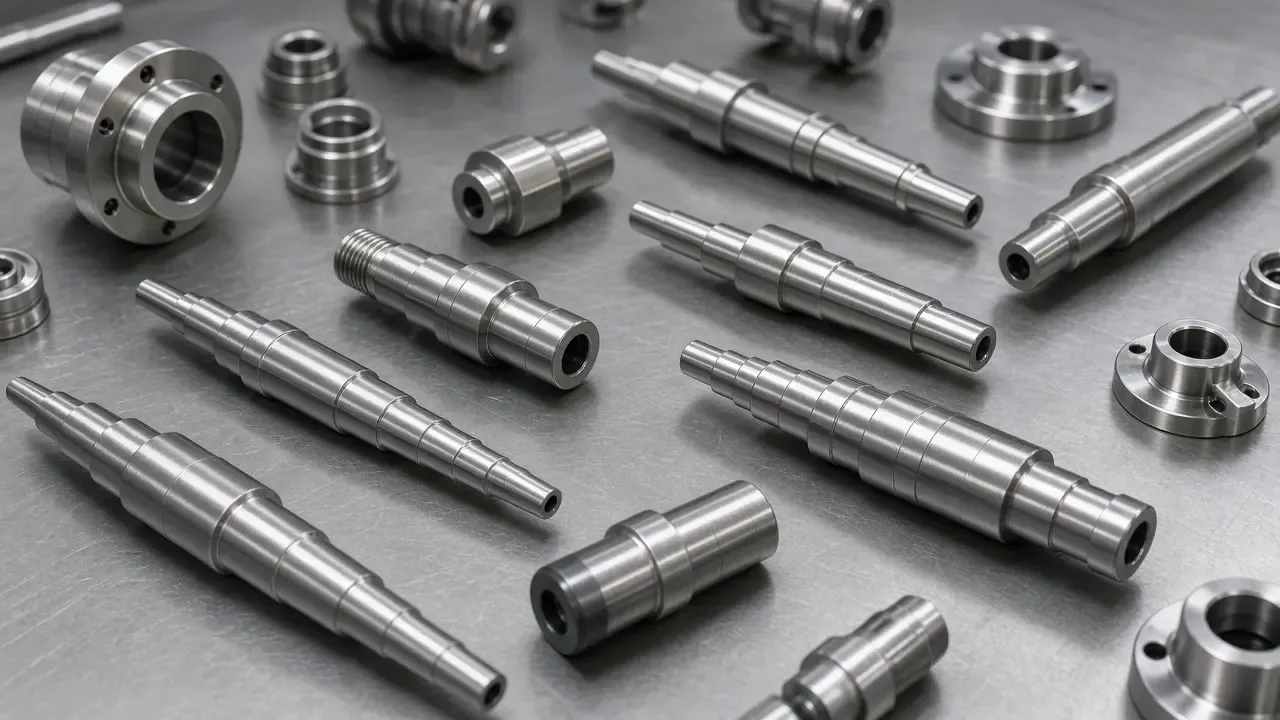
Low-carbon manganese-chromium case-hardening steel. After carburising and hardening the surface reaches 58–62 HRC while the core stays tough; an economical option for gears, pinions, shafts and pins in sections up to about 30 mm.
20MnCr5 Case-Hardening Steel
20MnCr5·5120
Case-hardening steel with carbon, manganese and chromium contents one step above 16MnCr5. Gives a core strength of 1000–1300 MPa in sections up to 60 mm; widely used for automotive gears, differential and propeller-shaft parts.
18CrNiMo7-6 Case-Hardening Steel
18CrNiMo7-6·~4820
Chromium-nickel-molybdenum case-hardening steel suited to heavy sections. Used for wind-turbine, gearbox and heavy-vehicle gears that need deep case depths (2 mm and above for large-module gears) and a core strength of 1100–1400 MPa.
15CrNi6 Case-Hardening Steel
15CrNi6·15CrNi6
Chromium-nickel alloyed case-hardening steel. After carburising, a 58–62 HRC surface sits over a core kept tough by nickel; used for shock-loaded gears, truck and construction-machinery driveline parts, and pins.
20NiCrMo2-2 (8620) Case-Hardening Steel
Available on Request
20NiCrMo2-2·8620·G86200
Case-hardening steel with low nickel, chromium and molybdenum additions (20NiCrMo2-2), equivalent to AISI 8620. After carburising it combines a hard, wear-resistant surface with a tough core. Supplied to specification, soft annealed or +FP, for small and medium-section machine parts such as gears, pinions and shafts.
16NiCrMo12 Case-Hardening Steel
Available on Request
~14NiCrMo13-4 (yakın)·~1.6657 (yakın)·~16NCD13
Case-hardening steel with 2.70–3.20 % nickel, chromium and molybdenum (UNI 7846: 16NiCrMo12). The closest EN grade is 14NiCrMo13-4 (1.6657), but the compositions are not identical. After carburising it combines a hard case with a tough, strong core thanks to its high nickel content; supplied annealed on request for highly loaded gears and rolling elements.
02.3
Nitriding Steels
Al / Cr / Mo / V alloyed; 800–1100 HV surface after nitriding with low distortion; EN 10085.
Typical applicationsExtruder screws, gears, mold pins, shafts
31CrMoV9 Nitriding Steel
31CrMoV9·31CrMoV9
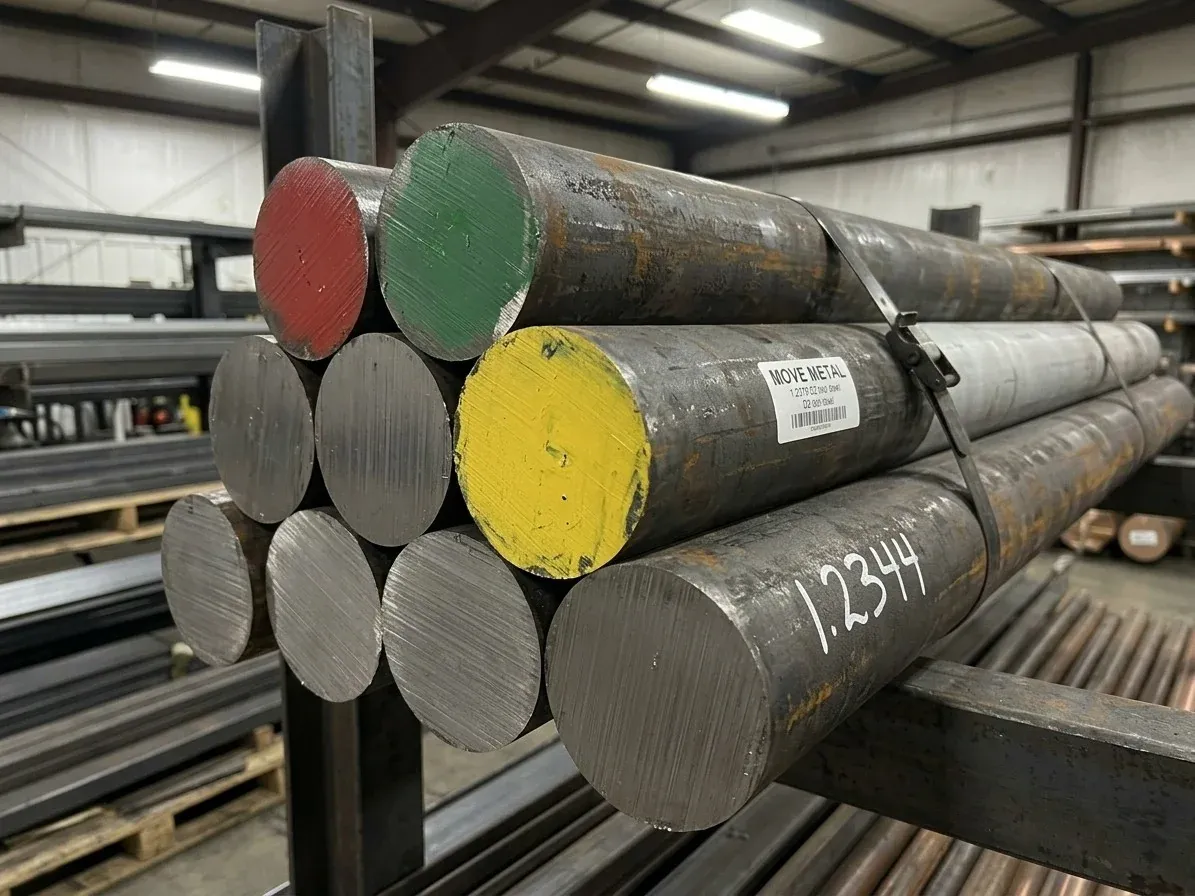
Vanadium-bearing chromium-molybdenum nitriding steel. Nitrided at 500–530 °C it reaches 800–950 HV at the surface while distortion stays very low; chosen for precision components such as extruder screws, crank and camshafts, and mould slides.
34CrAlNi7 Nitriding Steel
34CrAlNi7·34CrAlNi7-10
Nitriding steel alloyed with aluminium and nickel (34CrAlNi7-10). Aluminium allows surface hardness of 950–1100 HV after nitriding while nickel keeps the core tough; used for gauges, extruder screws and pump shafts where wear and dimensional stability matter.
31CrMo12 Nitriding Steel
31CrMo12
Aluminium-free nitriding steel with about 3 % chromium, supplied quenched and tempered. Nitriding gives an 800–900 HV surface while the nitrided layer stays tough; used for extruder screws, plastic mould components and hydraulic pistons.
02.4
Spring Steels
High elastic limit and fatigue strength; EN 10089.
Typical applicationsLeaf and coil springs, torsion bars, hand tools
51CrV4 (6150) Spring Steel
51CrV4·6150·G61500
Spring steel alloyed with chromium and vanadium (AISI 6150). Tough and fatigue-resistant at a spring hardness of 44–52 HRC, it is used for heavy-vehicle leaf springs, stabilisers, torsion bars, as well as spanners, pliers and other hand tools.
54SiCr6 Spring Steel
54SiCr6·~9254
Silicon-chromium alloyed spring steel. At a spring hardness of 48–54 HRC it resists relaxation, which makes it a common choice for valve, suspension and clutch springs operating at high stress.
03
Chemical Composition
| Grade | C | Si | Mn | Cr | Mo | Ni | V | Al |
|---|---|---|---|---|---|---|---|---|
| Quenched and Tempered Steels | ||||||||
| 42CrMo4 (4140) Engineering Steel | 0.38–0.45 | ≤0.40 | 0.60–0.90 | 0.90–1.20 | 0.15–0.30 | — | — | — |
| 34CrNiMo6 (4340) Engineering Steel | 0.30–0.38 | ≤0.40 | 0.50–0.80 | 1.30–1.70 | 0.15–0.30 | 1.30–1.70 | — | — |
| 25CrMo4 (4130) Engineering Steel | 0.22–0.29 | ≤0.40 | 0.60–0.90 | 0.90–1.20 | 0.15–0.30 | — | — | — |
| C45E (1045) Carbon Steel | 0.42–0.50 | ≤0.40 | 0.50–0.80 | — | — | — | — | — |
| 34CrMo4 (4135) Engineering Steel | 0.30–0.37 | ≤0.40 | 0.60–0.90 | 0.90–1.20 | 0.15–0.30 | — | — | — |
| 30CrNiMo8 Engineering Steel | 0.26–0.34 | ≤0.40 | 0.30–0.60 | 1.80–2.20 | 0.30–0.50 | 1.80–2.20 | — | — |
| C45U (1.1730) Carbon Steel | 0.42–0.50 | 0.15–0.40 | 0.60–0.80 | — | — | — | — | — |
| 4145H Engineering Steel | 0.42–0.49 | 0.15–0.35 | 0.65–1.10 | 0.75–1.20 | 0.15–0.25 | — | — | — |
| 4330V Engineering Steel | 0.28–0.33 | — | 0.75–1.00 | 0.75–1.00 | 0.35–0.50 | 1.65–2.00 | 0.05–0.10 | — |
| 100Cr6 (52100) Bearing Steel | 0.93–1.05 | 0.15–0.35 | 0.25–0.45 | 1.35–1.60 | ≤0.10 | — | — | — |
| 34Cr4 Engineering Steel | 0.30–0.37 | ≤0.40 | 0.60–0.90 | 0.90–1.20 | — | — | — | — |
| AISI 4340 Engineering Steel | 0.38–0.43 | 0.15–0.35 | 0.60–0.80 | 0.70–0.90 | 0.20–0.30 | 1.65–2.00 | — | — |
| Case-Hardening Steels | ||||||||
| 16MnCr5 Case-Hardening Steel | 0.14–0.19 | ≤0.40 | 1.00–1.30 | 0.80–1.10 | — | — | — | — |
| 20MnCr5 Case-Hardening Steel | 0.17–0.22 | ≤0.40 | 1.10–1.40 | 1.00–1.30 | — | — | — | — |
| 18CrNiMo7-6 Case-Hardening Steel | 0.15–0.21 | ≤0.40 | 0.50–0.90 | 1.50–1.80 | 0.25–0.35 | 1.40–1.70 | — | — |
| 15CrNi6 Case-Hardening Steel | 0.14–0.19 | ≤0.40 | 0.40–0.60 | 1.40–1.70 | — | 1.40–1.70 | — | — |
| 20NiCrMo2-2 (8620) Case-Hardening Steel | 0.17–0.23 | ≤0.40 | 0.65–0.95 | 0.35–0.70 | 0.15–0.25 | 0.40–0.70 | — | — |
| 16NiCrMo12 Case-Hardening Steel | 0.13–0.19 | 0.15–0.40 | 0.40–0.70 | 0.80–1.10 | 0.30–0.40 | 2.70–3.20 | — | — |
| Nitriding Steels | ||||||||
| 31CrMoV9 Nitriding Steel | 0.27–0.34 | ≤0.40 | 0.40–0.70 | 2.30–2.70 | 0.15–0.25 | — | 0.10–0.20 | — |
| 34CrAlNi7 Nitriding Steel | 0.30–0.37 | ≤0.40 | 0.40–0.70 | 1.50–1.80 | 0.15–0.25 | 0.85–1.15 | — | 0.80–1.20 |
| 31CrMo12 Nitriding Steel | 0.28–0.35 | ≤0.40 | 0.40–0.70 | 2.80–3.30 | 0.30–0.50 | — | — | — |
| Spring Steels | ||||||||
| 51CrV4 (6150) Spring Steel | 0.47–0.55 | ≤0.40 | 0.70–1.10 | 0.90–1.20 | — | — | 0.10–0.25 | — |
| 54SiCr6 Spring Steel | 0.51–0.59 | 1.20–1.60 | 0.50–0.80 | 0.50–0.80 | — | — | — | — |
Values in wt. %; ranges per each grade’s reference standard. The full list and reference standard are on the grade page. The analysis on the material certificate governs on delivery.
04
Mechanical Properties
For quenched and tempered steels, values are +QT minimums from EN 10083-3 and apply to the stated diameter range; for case-hardening, nitriding and spring steels, typical values after heat treatment are given. Mechanical values depend on section size and delivery condition.
| Grade | Condition | Tensile strength Rm (MPa) | Yield strength Rp0.2 (MPa) | Elongation A (%) | Hardness |
|---|---|---|---|---|---|
| 1.7225 (42CrMo4) | +A (soft annealed) | — | — | — | max. 241 HB |
| 1.7225 (42CrMo4) | +QT, 40 < d ≤ 100 mm | 900–1100 | ≥ 650 | ≥ 12 | — |
| 1.6582 (34CrNiMo6) | +QT, 40 < d ≤ 100 mm | 1000–1200 | ≥ 800 | ≥ 11 | — |
| 4145H | +QT, to specification (e.g. API 7-1) | — | — | — | Typically ≈ 28–36 HRC |
| 1.7131 (16MnCr5) | Carburised + hardened + tempered | ≈ 800–1100 (core) | — | — | Surface 58–62 HRC |
| 1.7147 (20MnCr5) | Carburised + hardened + tempered | ≈ 1000–1300 (core) | — | — | Surface 58–62 HRC |
| 1.6587 (18CrNiMo7-6) | Carburised + hardened + tempered | ≈ 1100–1400 (core) | — | — | Surface 58–62 HRC |
| 1.8519 (31CrMoV9) | +QT + nitrided | ≈ 1000–1200 (core) | — | — | Core 30–36 HRC; surface 800–950 HV |
| 1.8159 (51CrV4) | Hardened + tempered (spring) | ≈ 1300–1700 | — | — | 44–52 HRC |
| 1.3505 (100Cr6) | Hardened + low-temperature tempered | — | — | — | 60–64 HRC |
Values are minimum/typical and approximate. For other diameter ranges and delivery conditions, the relevant standard table, the applicable order specification and the material certificate govern.
05
Physical Properties
Approximate values at room temperature; small differences occur with alloy content and heat-treatment condition.
| Group / grade | Density (g/cm³) | Modulus of elasticity (GPa) | Thermal conductivity (W/m·K) | Coefficient of thermal expansion (10⁻⁶/K, 20–100 °C) |
|---|---|---|---|---|
| Non-alloy Q&T — C45E / C45U | ≈ 7.85 | ≈ 210 | ≈ 45–50 | ≈ 11–12 |
| Cr-Mo Q&T — 25CrMo4 / 34CrMo4 / 42CrMo4 | ≈ 7.85 | ≈ 210 | ≈ 42 | ≈ 11–12 |
| Ni-Cr-Mo — 34CrNiMo6 / 30CrNiMo8 / 18CrNiMo7-6 | ≈ 7.85 | ≈ 210 | — | ≈ 11–12 |
| Case-hardening Mn-Cr — 16MnCr5 / 20MnCr5 | ≈ 7.85 | ≈ 210 | — | ≈ 11–12 |
| Nitriding and spring — 31CrMoV9 / 34CrAlNi7 / 51CrV4 | ≈ 7.8–7.85 | ≈ 210 | — | ≈ 11–12 |
| Bearing — 100Cr6 | ≈ 7.8 | ≈ 210 | — | ≈ 11–12.5 |
Approximate values; cells left as "—" where no reliable value is given. Use the producer data sheet for design values.
06
Applications
- Mechanical engineering: shafts, axles, couplings, bolts and studs
- Automotive and construction machinery: gears, crankshafts and camshafts, driveline parts
- Power transmission: gearbox gears, pinions, sprockets
- Oil and gas: drill collars, drill string components, valve and pump shafts
- Hydraulics and pneumatics: piston rods and cylinder parts (chrome-plated bar)
- Plastics and rubber machinery: extruder screws and barrels (nitriding steels)
- Bearings: balls, rollers and rings (100Cr6)
- Springs: leaf and coil springs, torsion bars, stabiliser bars
- Heavy industry: large-section forged shafts and heavily loaded components
07
Product Forms & Delivery Conditions
Product forms
- Round bar
- Peeled bar
- Ground shafting
- Hexagon
- Flat bar
- Plate
- Forgings
- Cut to size
Availability of forms and sizes depends on grade and delivery condition.
Delivery conditions
- +A: soft annealed
- +N: normalised
- +QT: quenched and tempered
- +FP: treated to ferrite-pearlite structure (case-hardening steels, for machinability)
- +AC: spheroidise annealed (100Cr6)
- +C / +SH: cold drawn, peeled
- Grades with guaranteed hardenability band (+H), on request
- Ground and chrome-plated bar (on request)
08
Applicable Standards & Certification
Product standards and specifications
- EN 10083-1 / -2 / -3 — Steels for quenching and tempering (non-alloy and alloy)
- EN 10084 — Case-hardening steels
- EN 10085 — Nitriding steels
- EN 10089 — Hot rolled steels for quenched and tempered springs
- EN ISO 683-17 — Ball and roller bearing steels (100Cr6)
- EN 10277 — Bright steel products (cold drawn, peeled, ground)
- ASTM A304 — Carbon and alloy steel bars subject to hardenability requirements (H)
- API Spec 7-1 — Rotary drill stem elements (4145H drill collars)
- EN 10060 — Dimensional tolerances for hot rolled round bars
Certification and inspection documents
- EN 10204 3.1 inspection certificate (chemical analysis, mechanical tests)
- EN 10204 3.2 inspection certificate (on request, third party)
- Tensile and impact (Charpy KV) test report
- Jominy end-quench test (EN ISO 642) report
- Ultrasonic testing (e.g. EN 10308 for bars, EN 10228-3 for forgings)
- Inclusion rating (e.g. EN 10247, ASTM E45)
- PMI (positive material identification), on request
A product specification and an inspection document are different things: e.g. AMS 4928 is a product specification, EN 10204 3.1 is a type of inspection document; one does not replace the other.
Section size and delivery condition decide
The same grade gives very different mechanical values depending on section size and delivery condition. State the diameter/thickness, the required condition and the test location (surface/core) in your request; we verify the suitable grade together.
Technical supportMaterial Availability & Supply Capability
Move Metal is not a producer; we focus on technical supply and international sourcing. The supply status of each grade is shown with the statuses below; a grade listed on the site does not mean it is held in stock.
- Regular Supply
- Materials with an established supply relationship, available for recurring requirements.
- Available on Request
- Materials sourced on request through our international producer and supplier network.
- Special Sourcing
- Requirements calling for special dimensions, certification or producer approval, sourced individually.
- Under Development
- Materials we are working to bring into our supply scope.
Please Include
- Grade and standard (e.g. EN 10083-3, 42CrMo4)
- Diameter / thickness, length and tolerance
- Delivery condition (+A, +N, +QT, +FP, +SH…)
- Mechanical values (Rm, Rp0.2, A, KV) and test location (surface / core)
- Hardenability (Jominy) band
- Cleanliness / inclusion rating
- Ultrasonic testing
- Certificate: EN 10204 3.1 / 3.2
Have a material requirement?
Send us your specification, drawing or RFQ. Our team will review the requirement and identify a suitable supply option.