
AISI 4340 Engineering Steel
4340
Available on Request
- AISI4340
- SAE4340
- UNSG43400
- AMS6415
Nickel-chromium-molybdenum steel for quenching and tempering with high hardenability (AISI 4340, UNS G43400). Hardening and tempering take it across a wide strength range, from about 1000 MPa to over 1900 MPa, combining strength with toughness and fatigue resistance. Supplied on request to SAE J404 / ASTM chemistry or to AMS 6414 (VAR) / AMS 6415 for aircraft landing gear, heavily loaded shafts and gears.
Spectral Analysis
wt. % · SAE J404 ranges- C
- 0.38–0.43
- Si
- 0.15–0.35
- Mn
- 0.60–0.80
- Cr
- 0.70–0.90
- Mo
- 0.20–0.30
- Ni
- 1.65–2.00
Typical ranges according to the standard, for information only. The analysis on the material certificate applies on delivery.
01Material Properties
- Rm ≈ 1000–1950 MPa depending on tempering temperature
- High hardenability; uniform strength in large sections
- Good toughness and fatigue strength at high strength levels
- Suitable for nitriding and induction hardening
- Not the same alloy as 34CrNiMo6 (1.6582): higher carbon and nickel, lower chromium
02Applications
- Aircraft landing gear and structural aerospace parts
- Heavily loaded shafts, axles and crankshafts
- Large gears and pinions
- High-strength bolts and fasteners
- Defence and hydraulic components
- Oil and gas equipment (drilling tools, shafts)
03Delivery Condition
- Annealed, normalised and tempered, or quenched and tempered (+QT); hardness and strength class per order specification.
- For aerospace applications, to AMS 6414 (vacuum arc remelted, VAR) or AMS 6415 (air melted) on request.
04Heat Treatment
Heat Treatment Steps
Tempering Diagram
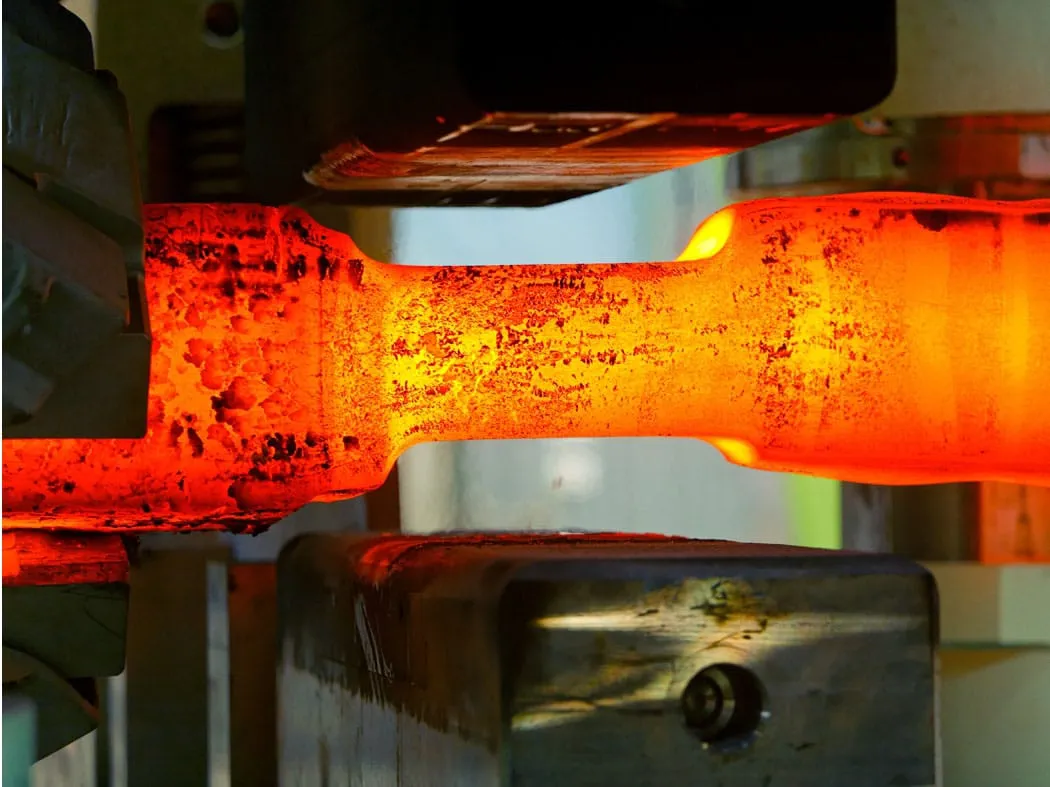
High-strength parts are baked for hydrogen relief after electroplating. Aerospace parts are heat treated to AMS 2759/1 or AMS 2759/2; values are typical and the applicable specification governs for orders.
05Mechanical Properties
Typical values by delivery and heat-treatment condition (small oil-quenched specimen); strength is lower in large sections.
| Condition | Rm (MPa) | Rp0.2 (MPa) | Hardness |
|---|---|---|---|
| Annealed | ≈ 745 | ≈ 470 | ≈ 217 HB |
| Normalised | ≈ 1280 | ≈ 860 | ≈ 363 HB |
| Hardened + tempered at 205 °C | ≈ 1980 | ≈ 1860 | ≈ 520 HB |
| Hardened + tempered at 315 °C | ≈ 1760 | ≈ 1620 | ≈ 486 HB |
| Hardened + tempered at 425 °C | ≈ 1500 | ≈ 1365 | ≈ 430 HB |
| Hardened + tempered at 540 °C | ≈ 1240 | ≈ 1160 | ≈ 360 HB |
| Hardened + tempered at 650 °C | ≈ 1020 | ≈ 860 | ≈ 280 HB |
Typical values; guaranteed values follow the relevant specification (e.g. ASTM A434 classes, AMS 6414 / AMS 6415, customer specification). The applicable specification and material certificate govern for orders.
06Applicable Standards & Specifications
- SAE J404 — Chemical compositions of alloy steels (4340)
- ASTM A29 — Hot-wrought steel bars, general requirements (4340)
- ASTM A322 — Alloy steel bars (4340)
- ASTM A434 — Quenched and tempered alloy steel bars (4340; classes BB / BC / BD)
- AMS 6415 — 4340 bars, forgings and tubing (aerospace, on request)
- AMS 6414 — 4340, vacuum arc remelted (VAR / CEVM) bars, forgings and tubing (on request)
- AMS 2759/1, AMS 2759/2 — Heat treatment of low-alloy steel parts (aerospace)
A product specification and an inspection document are different things: e.g. AMS 4928 is a product specification, EN 10204 3.1 is a type of inspection document; one does not replace the other.
07Microstructure & Metallurgical Properties
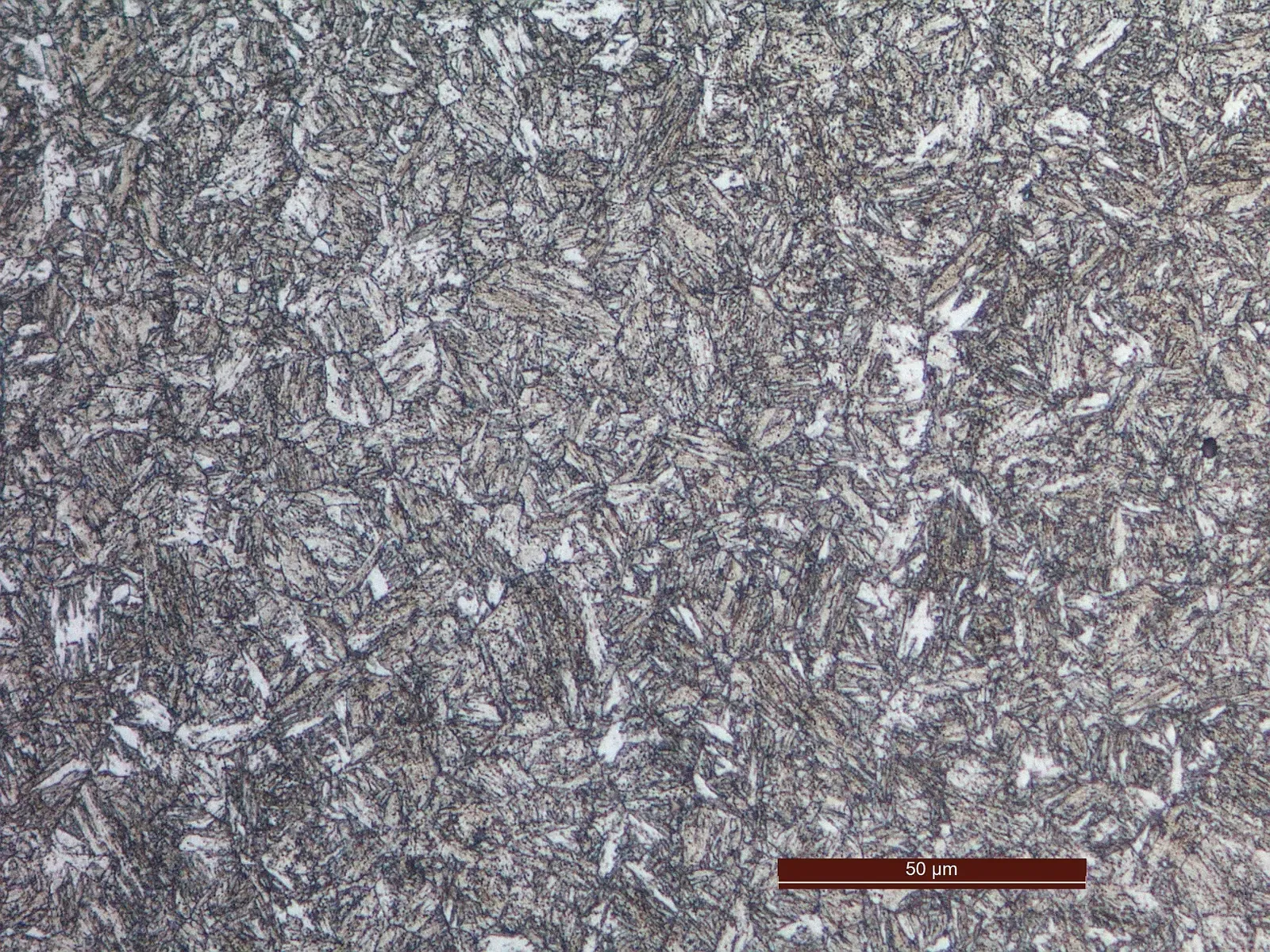
Typical microstructure information4340 is a nickel-chromium-molybdenum steel for quenching and tempering. Its microstructure depends on the delivery and heat treatment condition; when hardened and tempered it typically consists of tempered martensite, which its high hardenability allows to form through to the core of large sections.
Typical metallurgical characteristics
- Tempered martensitic structure in the QT condition
- High hardenability; through-hardening of large sections
- Toughness enhanced by nickel
- Tendency to embrittlement when tempered at ≈ 260–370 °C
- Properties influenced by hardening and tempering parameters
- 1.Typical microstructure
- Hardened and tempered: tempered martensite; bainite may be present in the core of very large sections. Annealed: ferrite and pearlite or spheroidised carbides.
- 2.Heat treatment influence
- Hardening temperature and cooling rate control the martensite fraction; the tempering temperature (200–650 °C) sets the balance between strength and toughness. Annealed, normalised and quenched-and-tempered 4340 do not show the same microstructure.
- 3.Grain structure
- Prior austenite grain size depends on austenitising temperature and time; fine-grained production is typical. Excessive austenitising temperature can cause grain growth and loss of toughness.
- 4.Carbide / precipitate distribution
- Carbides enriched in chromium and molybdenum precipitate during tempering. Nickel remains in solid solution and contributes to matrix toughness. Vacuum arc remelted (VAR) material has a lower non-metallic inclusion content.
- 5.Metallographic examination
- Batch-specific metallographic examination is available upon request. A microstructure image alone does not prove chemical analysis, mechanical properties or certificate compliance.
Available technical documentation
- Chemical composition certificate
- Mechanical test report, where available
- Heat treatment information, where available
- Metallographic examination, upon request
Typical microstructure information. Actual microstructure may vary depending on manufacturing route, product form and heat treatment.
08Is there a better material?
Grades in the same material family as 4340 with higher wear resistance and higher impact resistance (toughness); up to two suggestions under each heading. Which one fits depends on the application's priority requirement.
Higher wear resistance
- 100Cr6 (52100) Bearing Steel
Wear resistance: Medium → High
Trade-off: Fatigue resistance, Toughness
- 20NiCrMo2-2 (8620) Case-Hardening Steel
Wear resistance: Medium → High
Trade-off: Strength, Fatigue resistance
Higher impact resistance (toughness)
- 4330V Engineering Steel
Toughness: High · same level, tougher within the family (toughness ranking 65 → 72)
Trade-off: Fatigue resistance
- 18CrNiMo7-6 Case-Hardening Steel
Toughness: High · same level, tougher within the family (toughness ranking 65 → 72)
Suggestions are based on the critical property levels in our grade data; an improvement in one property may require a trade-off in another. The final selection must be made by technical evaluation against operating conditions, heat treatment and specification.
For more information, browse our Technical Insights09Move Metal Supply Options
Move Metal is not a producer; we source the grade to your specification through our international producer and supplier network. Dimensions, quantity, delivery condition and documentation requirements are reviewed together.
Product forms
- Round bar
- Peeled bar
- Ground shafting
- Hexagon
- Flat bar
- Plate
- Forgings
- Cut to size
Documents and testing
- EN 10204 3.1 inspection certificate (chemical analysis, mechanical tests)
- EN 10204 3.2 inspection certificate (on request, third party)
- Tensile and impact (Charpy KV) test report
- Jominy end-quench test (EN ISO 642) report
- Ultrasonic testing (e.g. EN 10308 for bars, EN 10228-3 for forgings)
Supply status: Available on Request
Request 4340 QuotationNot sure if 4340 is the right material for your application?
Evaluate candidate materials by application, operating conditions and priority properties with the Material Selection Guide.
Find the Right MaterialGrades in the Same Group
Back to GroupTechnical resources for this material
Have a material requirement?
Send us your specification, drawing or RFQ. Our team will review the requirement and identify a suitable supply option.