

Hot Work • Cold Work • Plastic Mold
Tool Steels
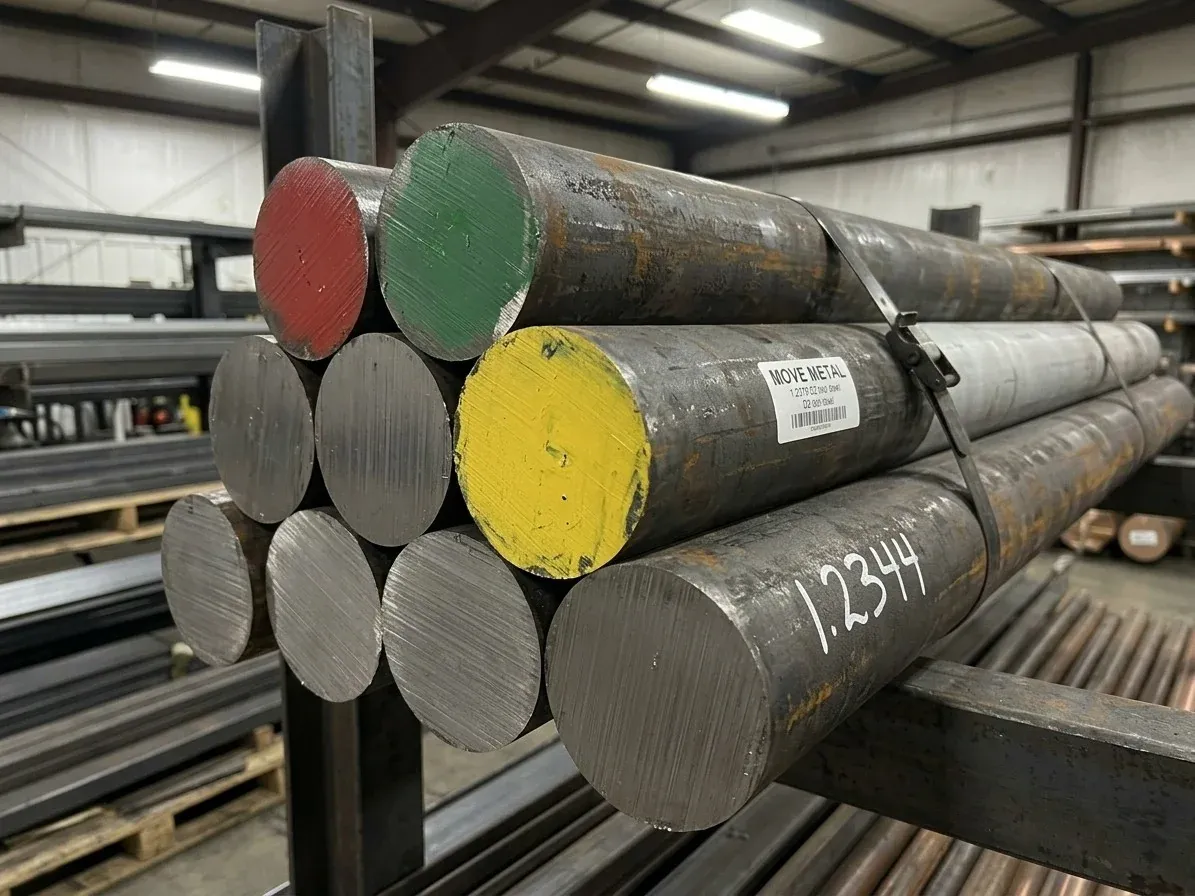
Tool steel supplier in Turkey with international sourcing. Tool steels for molds, dies, tooling, cutting applications and wear-resistant components. Move Metal supplies tool steels in different grades, dimensions and conditions according to customer requirements.
01
Overview
Tool steels are high-carbon and/or alloyed steels used in the hardened condition for molds, dies, punches, cutting and forming tools. EN ISO 4957 classifies them as non-alloy cold work, alloy cold work, hot work and high-speed steels; the AISI system uses the letter groups H, D, A, O, S, L and P. This page covers hot work, cold work and plastic mold steels; high-speed steels are a separate category. Most grades are delivered soft annealed and hardened after machining, while some plastic mold steels are used in the pre-hardened condition. Selection weighs operating temperature, type of wear, impact load, target hardness, section size and surface requirements (polishing, texturing).
- Hot work (1.2343, 1.2344, 1.2367): resistance to thermal fatigue and tempering; typical working hardness 42–52 HRC
- Cold work (1.2379, 1.2080, 1.2363, 1.2510, 1.2550): wear resistance and edge strength; typical working hardness 50–64 HRC
- Plastic mold (1.2311, 1.2738, 1.2083): pre-hardened or through-hardened; polishability and dimensional stability
- ESR (electroslag remelted) grades: cleaner, more homogeneous structure for molds requiring polishing and toughness
- High-chromium ledeburitic grades offer high wear resistance with limited toughness; tougher grades are considered for impact loads
- As section size increases, hardenability (Cr, Mo, Ni) becomes decisive
02
Material Grades
02.1
Hot Work Tool Steels
Steels for hot forming, forging, extrusion and casting dies, selected for resistance to thermal fatigue and hot wear.
Typical applicationsHot forging dies, aluminium and pressure die casting dies, extrusion tooling, hot shear blades.
H11 Tool Steel
X37CrMoV5-1·H11
H11-type hot work steel alloyed with 5 % chromium, molybdenum and vanadium; lower carbon and vanadium than 1.2344 put the emphasis on toughness. Used at 44–52 HRC for forging dies, aluminium extrusion tooling and gravity die-casting molds.
H11 ESR Tool Steel
1.2343·X37CrMoV5-1·H11
Electro-slag remelted (ESR) quality of the H11-type Cr-Mo-V hot work steel. Its cleaner, more homogeneous structure improves toughness, polishability and texturing; used for forging and extrusion dies and also for plastic molds run above 48 HRC.
H13 Tool Steel
X40CrMoV5-1·H13
H13-type hot work steel (X40CrMoV5-1) with 5 % chromium and about 1 % vanadium. Hot strength, temper resistance and thermal-shock resistance suit it to aluminium extrusion, forging and die-casting tools at 44–52 HRC; it can be nitrided and coated.
1.2367
X38CrMoV5-3
Hot work steel (X38CrMoV5-3) with 5 % chromium and 2.70–3.20 % molybdenum. The high molybdenum content raises temper and creep resistance; used at 42–48 HRC for forging dies, extrusion tooling and hot zones of molds where early softening is a concern.
L6 Hot Work Tool Steel
55NiCrMoV7·L6
Ni-Cr-Mo-V alloyed hot work tool steel valued for its toughness under impact and thermal loading. Used for hammer and press forging dies, die holders, and bolsters and backers in aluminium extrusion tooling.
H10 Tool Steel
X32CrMoV3-3·H10
H10-type hot work steel (X32CrMoV3-3) with 3 % chromium and 3 % molybdenum. High thermal conductivity, resistance to thermal fatigue and tolerance of water cooling, with strength retained to about 600 °C, suit it to extrusion dies for aluminium and copper alloys and to forging dies.
H21 Tool Steel
X30WCrV9-3·H21
H21-type hot work steel (X30WCrV9-3) with 8.50–9.50 % tungsten. Hot hardness and temper resistance are high; with only moderate toughness it is run preheated and without water quenching, in brass and copper extrusion dies and hot pressing tools.
H13 ESR Tool Steel
1.2344·X40CrMoV5-1·H13
Electro-slag remelted grade of 1.2344 (AISI H13): same analysis, lower inclusion level. The homogeneous structure improves transverse toughness, polishability and texturing; used for die-casting shot sleeves and for high-volume plastic molds.
1.2367 ESR
1.2367·X38CrMoV5-3
ESR (electro-slag remelted) quality of the 3 % molybdenum hot work steel 1.2367. The lower inclusion content adds transverse toughness and polishability to the grade's high-temperature strength; used for hot-zone inserts, die-casting shot sleeves and heavily loaded extrusion tooling.
02.2
Cold Work Tool Steels
High-carbon alloy steels for cutting, punching, cold forming and applications requiring high wear resistance.
Typical applicationsCutting and punching dies, cold forming tools, roll forming, shear blades.
D3 Tool Steel
X210Cr12·D3
Ledeburitic cold work steel (X210Cr12 / AISI D3) with 1.90–2.20 % carbon and 11–13 % chromium. A high volume of chromium carbides gives strong resistance to abrasive wear; toughness is limited, so it suits cutting and forming work with low impact and tensile stresses.
1.2358
60CrMoV18-5
Cold work steel (60CrMoV18-5) with 4–4.8 % chromium and about 1 % molybdenum that can be surface hardened by flame, induction or laser. Easy weld repair makes it a choice for automotive body-panel, drawing and trimming dies; hardenable up to 58 HRC.
D2 Tool Steel
X153CrMoV12·D2
High-carbon (1.45–1.60 %) 12 % chromium cold work steel (AISI D2) with molybdenum and vanadium additions. Used where abrasive wear and compressive loads dominate, in blanking, slitting and forming dies, punches and industrial knives; can be high-temperature tempered and coated.
1.2767
X45NiCrMo4
Cold work tool steel with about 4% nickel, combining high hardenability with toughness. Used for thick-sheet cutting and bending tools, scrap shear blades and cold forging dies that work under impact loading.
O2 Cold Work Tool Steel
90MnCrV8·O2
Manganese-based cold work steel alloyed with chromium and vanadium and hardened in oil (AISI O2). Used for punches, small cutting and bending dies, gauges, and reamers and taps run at low cutting speeds.
A2 Tool Steel
X100CrMoV5·A2
Air-hardening cold work steel (AISI A2) with 1 % carbon and 5 % chromium. It distorts little in heat treatment and at 58–62 HRC balances wear resistance against toughness; used for blanking dies, punches and gauges that need more toughness than 1.2379.
O1 Tool Steel
100MnCrW4·O1
Oil-hardening cold work steel (AISI O1) alloyed with manganese, chromium and tungsten. A low hardening temperature and limited distortion bring it to 58–64 HRC; used for blanking dies, reamers, taps, woodworking knives and gauges.
D6 Tool Steel
X210CrW12·D6
Ledeburitic cold work steel (AISI D6) with 2.00–2.30 % carbon, 12 % chromium and tungsten. At 60–64 HRC it resists wear and edge dulling; as toughness is low it is used for impact-free duties such as thin-sheet blanking, wire drawing and ceramic pressing tools.
1.2990 Cold Work Tool Steel
X100CrMoV8-1-1
Cold work steel with 8% chromium plus molybdenum and vanadium, balancing wear resistance against toughness and hardened to 58–63 HRC. Since it can be tempered at high temperature, it suits fine blanking and forming tools that are to be PVD coated.
S1 (60WCrV8) Shock-Resisting Tool Steel
60WCrV8·S1
Cold work steel (60WCrV8 / AISI S1) with 1.70–2.20 % tungsten, intended for impact loading. At 54–58 HRC it combines toughness with edge strength; used for pneumatic chisels, shear blades, riveting dies and impact forming tools.
1.2360 MOD 8 % Chromium Cold Work Tool Steel
1.2360·X48CrMoV8-1-1·8 % Cr soğuk iş çeliği (K340 tipi)
An 8 % chromium cold work steel derived from 1.2360, with carbon raised to 1.05–1.15 % and molybdenum to 2.00–2.30 %. With higher toughness than 1.2379 and coatable thanks to secondary hardening, it is used at 58–62 HRC for thick-sheet blanking and high-volume punch tooling.
1.2360 (X48CrMoV8-1-1) 8 % Chromium Tool Steel
X48CrMoV8-1-1
Medium-carbon (0.45–0.55 %) tool steel with 8 % chromium and 1.3–1.7 % vanadium (X48CrMoV8-1-1). Tougher than conventional cold work grades, it is used at 56–60 HRC for cold forging dies, warm forging dies (200–400 °C), heavy-gauge punches and coated tooling.
1.2378 Cold Work Tool Steel
Available on Request
X220CrVMo13-4
High-carbon (approx. 2.2 %), high-vanadium ledeburitic cold work steel with 12–13 % chromium (X220CrVMo13-4). Its vanadium carbides give it higher abrasive wear resistance than D2-type steels such as 1.2379, at the cost of lower toughness. Supplied soft annealed to specification for blanking and pressing tools where long tool life is required.
02.3
Plastic Mold Steels
Steels selected for dimensional stability, machinability, polishability and corrosion resistance in injection and extrusion molds.
Typical applicationsPlastic injection molds, extrusion and blow molds, mold cores requiring high surface quality.
420 ESR Plastic Mold Steel
1.2083·X40Cr14·420
Electro-slag remelted (ESR) quality of the martensitic stainless mold steel X40Cr14 (AISI 420). The low inclusion content allows polishing to a mirror finish (A1+); used for molds processing corrosive plastics such as PVC and for food-industry parts.
1.2085
X33CrS16
Stainless holder steel (X33CrS16) with 15–17 % chromium and a sulphur addition, supplied pre-hardened to 280–325 HB. It machines easily and is used for mold holders whose cooling channels must not rust and for molds that need no high-gloss finish.
P20 Plastic Mold Steel
40CrMnMo7·P20
Chromium-manganese-molybdenum plastic mold steel (AISI P20), supplied pre-hardened to 280–320 HB. It contains no sulphur addition, can be welded and nitrided, and is used for injection-mold cores polished up to grade A2.
P20+S Plastic Mold Steel
40CrMnMoS8-6·P20+S
A P20 variant (40CrMnMoS8-6) with a sulphur addition for easier machining, supplied pre-hardened to 280–320 HB. Used for non-visible mold cores and holders; where texturing, polishing or welding is required, 1.2738 is recommended.
1.2316
X38CrMo16
Pre-hardened stainless plastic mold steel (X38CrMo16) with 15.5–17.5 % chromium and 0.80–1.30 % molybdenum. Used for injection and extrusion molds for corrosive polymers such as PVC, for calibration blocks and for mold holders.
P20+Ni Plastic Mold Steel
1.2738·40CrMnNiMo8-6-4·P20+Ni
Nickel-alloyed plastic mould steel supplied pre-hardened, with even hardness through the section and good response to texturing and polishing. A common choice for injection mould cores; 1.2738 HH is the higher-hardness variant.
1.2711 Mold Steel
54NiCrMoV6
Ni-Cr-Mo-V mold steel (54NiCrMoV6) with 1.50–1.80 % nickel. Pre-hardened to 360–410 HB, it keeps an even hardness and crack-resistant toughness in large sections; suited to large plastic molds, holder plates and forging blocks.
1.2162 Case-Hardening Mold Steel
21MnCr5
Low-carbon (0.18–0.24 %) manganese-chromium case-hardening mold steel (21MnCr5). In the annealed condition it is machined or hobbed; carburising brings the surface to 58–62 HRC while the core stays tough. Used for small and medium-size plastic molds.
1.2764 Case-Hardening Mold Steel
Available on Request
X19NiCrMo4
Chromium-molybdenum case-hardening mold steel with about 4 % nickel (X19NiCrMo4). After carburising it combines a hard, polishable surface with a tough nickel-alloyed core, and in the annealed condition it is suited to hobbing of mold cavities. Supplied soft annealed for plastic molds that need a high surface finish.
03
Chemical Composition
| Grade | C | Si | Mn | Cr | Mo | Ni | V | W |
|---|---|---|---|---|---|---|---|---|
| Hot Work Tool Steels | ||||||||
| H11 Tool Steel | 0.33–0.41 | 0.80–1.20 | 0.25–0.50 | 4.80–5.50 | 1.10–1.50 | — | 0.30–0.50 | — |
| H11 ESR Tool Steel | 0.33–0.41 | 0.80–1.20 | 0.25–0.50 | 4.80–5.50 | 1.10–1.50 | — | 0.30–0.50 | — |
| H13 Tool Steel | 0.35–0.42 | 0.80–1.20 | 0.25–0.50 | 4.80–5.50 | 1.20–1.50 | — | 0.85–1.15 | — |
| 1.2367 | 0.35–0.40 | 0.30–0.50 | 0.30–0.50 | 4.80–5.20 | 2.70–3.20 | — | 0.40–0.60 | — |
| L6 Hot Work Tool Steel | 0.50–0.60 | 0.10–0.40 | 0.60–0.90 | 0.80–1.20 | 0.35–0.55 | 1.50–1.80 | 0.05–0.15 | — |
| H10 Tool Steel | 0.28–0.35 | 0.10–0.40 | 0.15–0.45 | 2.70–3.20 | 2.60–3.00 | — | 0.40–0.70 | — |
| H21 Tool Steel | 0.25–0.35 | 0.15–0.50 | 0.20–0.50 | 2.50–3.20 | — | — | 0.30–0.50 | 8.50–9.50 |
| H13 ESR Tool Steel | 0.35–0.42 | 0.80–1.20 | 0.25–0.50 | 4.80–5.50 | 1.20–1.50 | — | 0.85–1.15 | — |
| 1.2367 ESR | 0.35–0.40 | 0.30–0.50 | 0.30–0.50 | 4.80–5.20 | 2.70–3.20 | — | 0.40–0.60 | — |
| Cold Work Tool Steels | ||||||||
| D3 Tool Steel | 1.90–2.20 | 0.10–0.60 | 0.20–0.60 | 11.0–13.0 | — | — | — | — |
| 1.2358 | 0.55–0.65 | 0.30–0.60 | 0.60–0.90 | 4.00–4.80 | 0.90–1.30 | — | 0.15–0.25 | — |
| D2 Tool Steel | 1.45–1.60 | 0.10–0.60 | 0.20–0.60 | 11.0–13.0 | 0.70–1.00 | — | 0.70–1.00 | — |
| 1.2767 | 0.40–0.50 | 0.10–0.40 | 0.20–0.50 | 1.20–1.50 | 0.15–0.35 | 3.80–4.30 | — | — |
| O2 Cold Work Tool Steel | 0.85–0.95 | 0.10–0.40 | 1.80–2.20 | 0.20–0.50 | — | — | 0.05–0.20 | — |
| A2 Tool Steel | 0.95–1.05 | 0.10–0.40 | 0.40–0.80 | 4.80–5.50 | 0.90–1.20 | — | 0.15–0.35 | — |
| O1 Tool Steel | 0.90–1.05 | 0.10–0.40 | 1.00–1.20 | 0.50–0.70 | — | — | 0.05–0.15 | 0.50–0.70 |
| D6 Tool Steel | 2.00–2.30 | 0.10–0.40 | 0.30–0.60 | 11.0–13.0 | — | — | — | 0.60–0.80 |
| 1.2990 Cold Work Tool Steel | 0.95–1.05 | 0.80–1.00 | 0.70–0.90 | 7.80–8.30 | 0.90–1.10 | — | 0.90–1.10 | — |
| S1 (60WCrV8) Shock-Resisting Tool Steel | 0.55–0.65 | 0.70–1.00 | 0.15–0.45 | 0.90–1.20 | — | — | 0.10–0.20 | 1.70–2.20 |
| 1.2360 MOD 8 % Chromium Cold Work Tool Steel | 1.05–1.15 | 0.80–1.10 | 0.35–0.50 | 7.80–8.50 | 2.00–2.30 | — | 0.45–0.55 | — |
| 1.2360 (X48CrMoV8-1-1) 8 % Chromium Tool Steel | 0.45–0.55 | 0.80–1.20 | 0.30–0.50 | 7.50–8.50 | 1.30–1.70 | — | 1.30–1.70 | — |
| 1.2378 Cold Work Tool Steel | 2.10–2.30 | — | — | 12.0–13.0 | — | — | — | — |
| Plastic Mold Steels | ||||||||
| 420 ESR Plastic Mold Steel | 0.36–0.42 | ≤1.00 | ≤1.00 | 12.5–14.5 | — | — | — | — |
| 1.2085 | 0.28–0.38 | ≤1.00 | ≤1.40 | 15.0–17.0 | — | ≤1.00 | — | — |
| P20 Plastic Mold Steel | 0.35–0.45 | 0.20–0.40 | 1.30–1.60 | 1.80–2.10 | 0.15–0.25 | — | — | — |
| P20+S Plastic Mold Steel | 0.35–0.45 | 0.30–0.50 | 1.40–1.60 | 1.80–2.00 | 0.15–0.25 | — | — | — |
| 1.2316 | 0.33–0.45 | ≤1.00 | ≤1.50 | 15.5–17.5 | 0.80–1.30 | ≤1.00 | — | — |
| P20+Ni Plastic Mold Steel | 0.35–0.45 | 0.20–0.40 | 1.30–1.60 | 1.80–2.10 | 0.15–0.25 | 0.90–1.20 | — | — |
| 1.2711 Mold Steel | 0.50–0.60 | 0.10–0.40 | 0.50–0.80 | 0.60–0.80 | 0.25–0.35 | 1.50–1.80 | 0.07–0.12 | — |
| 1.2162 Case-Hardening Mold Steel | 0.18–0.24 | 0.15–0.35 | 1.10–1.40 | 1.00–1.30 | — | — | — | — |
| 1.2764 Case-Hardening Mold Steel | 0.16–0.22 | — | — | 1.10–1.40 | 0.15–0.25 | 3.80–4.30 | — | — |
Values in wt. %; ranges per each grade’s reference standard. The full list and reference standard are on the grade page. The analysis on the material certificate governs on delivery.
04
Mechanical Properties
For tool steels, mechanical properties are expressed mainly as hardness. Values are typical delivery and heat-treatment data; the hardness achieved depends on section size and on hardening and tempering conditions.
| Grade | Delivery condition | As-hardened (HRC) | Working hardness (HRC) | Key characteristic |
|---|---|---|---|---|
| 1.2343 (H11) | Soft annealed, max. 229 HB | ≈ 52–54 | 42–52 | High toughness and ductility |
| 1.2344 (H13) | Soft annealed, max. 229 HB | ≈ 52–54 | 44–52 | Hot strength, thermal shock resistance |
| 1.2367 | Soft annealed, max. 229 HB | ≈ 52–55 | 42–48 | Tempering and creep resistance |
| 1.2714 (L6) | Soft annealed, max. 250 HB, or pre-hardened 36–42 HRC | ≈ 56–58 | 36–48 | High toughness, uniform hardness in large sections |
| 1.2379 (D2) | Soft annealed, max. 255 HB | ≈ 63–65 | 56–62 | High wear resistance; suitable for PVD after high-temperature tempering |
| 1.2080 (D3) | Soft annealed, max. 250 HB | ≈ 63–65 | 58–63 | Very high wear resistance, limited toughness |
| 1.2363 (A2) | Soft annealed, max. 241 HB | ≈ 62–64 | 58–62 | Air hardening, low distortion |
| 1.2510 (O1) | Soft annealed, max. 229 HB | ≈ 63–65 | 58–63 | Oil hardening, low hardening temperature |
| 1.2550 (S1) | Soft annealed, max. 229 HB | ≈ 57–59 | 50–58 | High toughness and impact strength |
| 1.2311 (P20) | Pre-hardened, 280–325 HB | ≈ 50–52 (if re-hardened) | As delivered | Uniform hardness across the section, nitridable |
| 1.2738 (P20+Ni) | Pre-hardened, 280–325 HB (HH: 340–390 HB) | ≈ 50–52 (if re-hardened) | As delivered | Uniform hardness in large sections, texturing and polishing |
| 1.2083 ESR | Soft annealed, max. 241 HB | ≈ 54–56 | 48–54 | Corrosion resistance, high polishability |
Values are typical/approximate and match the data on the grade pages. The applicable specification and material certificate govern for orders.
05
Physical Properties
Approximate values at room temperature. Thermal conductivity and expansion change with temperature; mold design should be based on producer data.
| Group / grade | Density (g/cm³) | Modulus of elasticity (GPa) | Thermal conductivity (W/m·K) | Coefficient of thermal expansion (10⁻⁶/K, 20–100 °C) |
|---|---|---|---|---|
| Hot work — 1.2343 / 1.2344 | ≈ 7.8 | ≈ 210 | ≈ 25 | ≈ 10.5–11.5 |
| Cold work, 12% Cr — 1.2379 / 1.2080 | ≈ 7.7 | ≈ 210 | ≈ 20 | ≈ 10.5 |
| Plastic mold — 1.2311 / 1.2738 | ≈ 7.8–7.85 | ≈ 205–210 | ≈ 29–34 | — |
| Stainless plastic mold — 1.2083 / 1.2316 | ≈ 7.7 | ≈ 200–215 | — | ≈ 10–11 |
Approximate values; cells left as "—" where no reliable value is given. Use the producer data sheet and material certificate for design values.
06
Applications
- Die casting: aluminium, magnesium and zinc die casting dies
- Hot forging and extrusion: forging dies, extrusion dies, mandrels
- Sheet metal forming: blanking, punching and deep drawing dies
- Cold forming: cold forging, thread rolling and roll forming tools
- Cutting: shear, guillotine and slitting blades
- Impact tooling: punches, chisels, pneumatic tools
- Plastic injection: mold bases, cores and cavity inserts
- Corrosive plastics and high gloss: PVC molds, optical and medical part molds
07
Product Forms & Delivery Conditions
Product forms
- Round bar
- Flat bar
- Plate
- Block
- Cut-to-size
Available forms may vary by grade and dimension.
Delivery conditions
- Soft annealed (+A); max. approx. 229–255 HB depending on grade
- Pre-hardened: 280–325 HB for 1.2311 / 1.2738, 340–390 HB for 1.2738 HH, 360–410 HB for 1.2711
- Hardened + tempered: on request, with heat-treatment coordination
- Conventional or ESR (electroslag remelted) production
- Black (hot rolled / forged), peeled, milled or ground surface
- Cut to size; blocks and plates with machining allowance
08
Applicable Standards & Certification
Product standards and specifications
- EN ISO 4957 — Tool steels
- DIN 17350 — Tool steels (withdrawn; material numbers still widely used)
- ASTM A681 — Alloy tool steels (H, D, A, O, S, L, P)
- JIS G4404 — Alloy tool steels (SKD, SKT)
- NADCA #207 — Hot work die steel and heat-treatment acceptance criteria for die casting dies
- SEP 1614 — Microstructural evaluation of hot work tool steels
- EN 10060 / EN 10058 / EN 10029 — Dimensional tolerances for hot rolled rounds, flats and plates
Certification and inspection documents
- EN 10204 3.1 inspection certificate (chemical analysis, delivery hardness)
- EN 10204 3.2 inspection certificate (on request, third party)
- Ultrasonic testing (e.g. SEP 1921, EN 10228-3)
- Microstructure and inclusion rating (e.g. SEP 1614, ASTM E45, EN 10247)
- Hardness test report (HB / HRC)
- Heat-treatment report (for hardened deliveries)
- PMI (positive material identification), on request
A product specification and an inspection document are different things: e.g. AMS 4928 is a product specification, EN 10204 3.1 is a type of inspection document; one does not replace the other.
Why Tool Steel Selection Matters
Tool steel selection depends not only on grade, but also on hardness, heat treatment, toughness, wear resistance, operating temperature, dimensional requirements and application. Asking for "H13" is rarely the whole story; delivery condition, tolerance and heat-treatment target define the supply solution.
Material Availability & Supply Capability
Move Metal is not a producer; we focus on technical supply and international sourcing. The supply status of each grade is shown with the statuses below; a grade listed on the site does not mean it is held in stock.
- Regular Supply
- Materials with an established supply relationship, available for recurring requirements.
- Available on Request
- Materials sourced on request through our international producer and supplier network.
- Special Sourcing
- Requirements calling for special dimensions, certification or producer approval, sourced individually.
- Under Development
- Materials we are working to bring into our supply scope.
Please Include
- Grade (material no. / AISI) or equivalent standard
- Dimensions, tolerance and machining allowance
- Delivery condition: soft annealed, pre-hardened or hardened
- Target working hardness
- ESR requirement
- Ultrasonic testing and microstructure requirements
- Certificate: EN 10204 3.1 / 3.2
- Quantity
Have a material requirement?
Send us your specification, drawing or RFQ. Our team will review the requirement and identify a suitable supply option.